
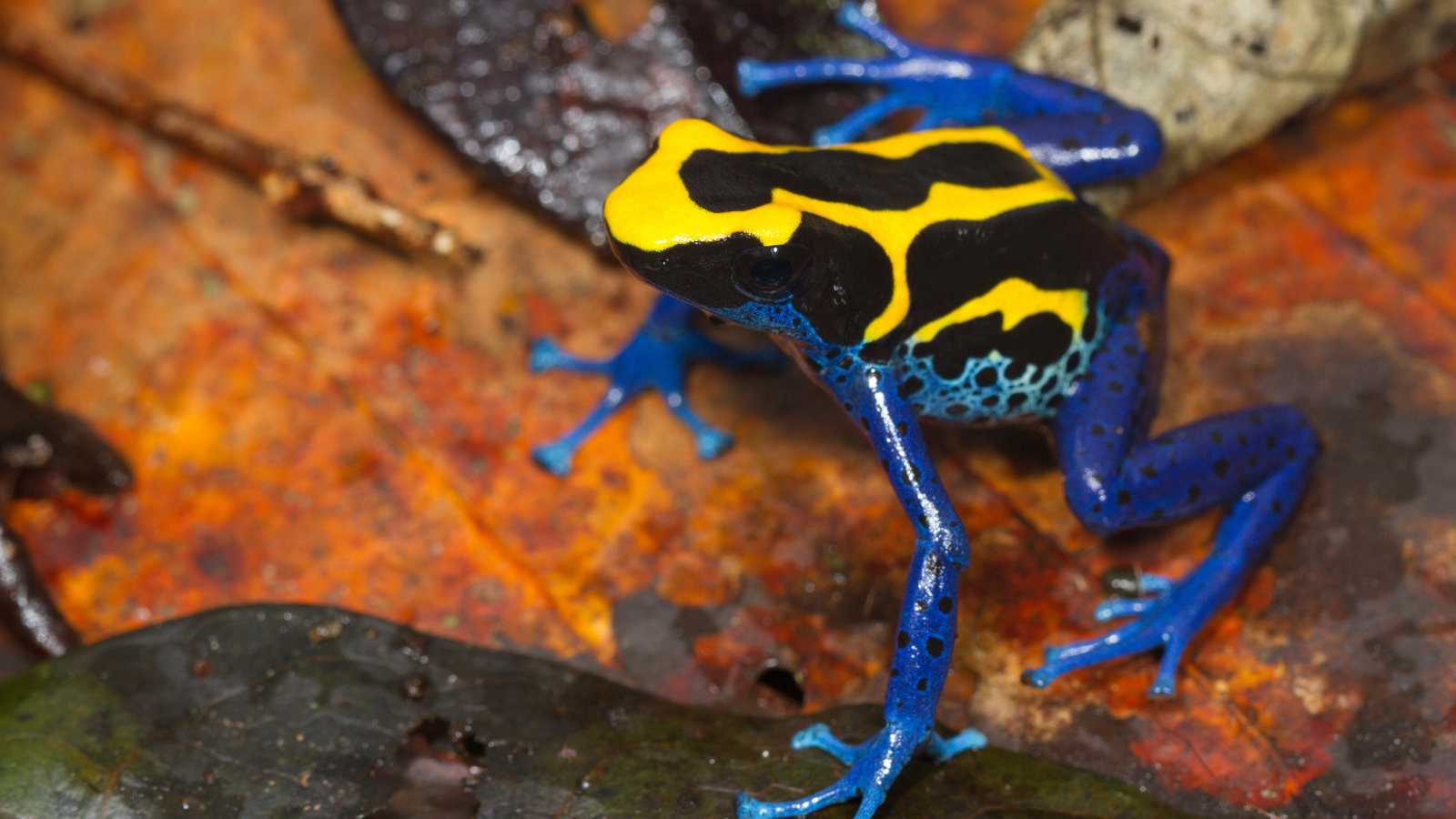

Poison dart frogs are some of the smallest yet most chemically powerful animals on Earth. Native primarily to the rainforests of Central and South America, these frogs belong mostly to the family Dendrobatidae and are famous for their intense colors, tiny size, and astonishing toxicity. Their vivid patterns are not decoration or coincidence. They are warnings. In the wild, bright coloration is often nature’s way of saying “do not touch,” and poison frogs are among the clearest examples of this strategy.
What makes these frogs especially fascinating is that most of their toxicity does not come from their own biology alone, but from their diet. Ants, mites, termites, and other small arthropods contain alkaloid compounds that the frogs absorb and store in specialized skin glands. Over time, these chemicals accumulate, turning the frog’s skin into a potent chemical defense capable of sickening, paralyzing, or killing predators. In captivity, when their diet changes, many poison frogs lose their toxicity entirely.
Despite their deadly reputation, poison frogs are not aggressive. They do not bite, sting, or chase threats. Their toxins are passive defenses, activated only when a predator makes physical contact. Historically, indigenous tribes recognized the power of these chemicals and used them to coat blowgun darts, turning small projectiles into lethal hunting tools. Even today, scientists study these toxins for potential medical applications, including pain management and neurological research.
Below are sixteen of the deadliest and most remarkable poison frogs known to science, each with its own unique appearance, chemical profile, and ecological story.
16 Deadly Poison Frogs
1- Golden Poison Dart Frog

The golden poison dart frog is widely regarded as the most toxic frog on the planet and possibly one of the most poisonous animals ever studied. Its bright yellow coloration serves as a bold visual warning, visible even in the dim light of dense rainforest understory. This species inhabits a very limited range along the Pacific coast of Colombia, where it lives among leaf litter and low vegetation.
The toxin carried by this frog, batrachotoxin, is extraordinarily powerful. A single adult frog can contain enough poison to kill multiple humans if the toxin enters the bloodstream. The compound interferes with nerve function by preventing sodium channels from closing, leading to uncontrolled nerve firing, muscle paralysis, and eventually cardiac failure.
Despite its lethal chemistry, the golden poison dart frog is a quiet, slow-moving animal that poses no danger unless touched. Sadly, habitat destruction and pollution have caused its population to decline sharply, placing it at serious risk despite its formidable defenses.
2- Blue Poison Dart Frog

The blue poison dart frog is instantly recognizable due to its vibrant blue skin marked with irregular black spots. Each individual frog has a unique pattern, almost like a fingerprint. This species is found primarily in southern Suriname and parts of northern Brazil, where it inhabits humid forest floors near streams.
Although less toxic than the golden poison dart frog, the blue poison dart frog still carries enough toxins to cause serious harm to predators and humans. Its chemical defenses can induce muscle weakness, nausea, and neurological distress. Like many poison frogs, it loses its toxicity in captivity due to dietary changes.
Its striking appearance has made it popular in the exotic pet trade, which has contributed to pressure on wild populations. In nature, however, its bright blue coloring ensures that predators quickly learn to avoid it.
3- Black-Legged Poison Dart Frog

The black-legged poison dart frog closely resembles the golden poison dart frog, and the two are closely related. Found in Colombia, this species belongs to the same genus and shares similar chemical defenses, though in slightly lower concentrations.
Historically, its toxins were used by indigenous peoples to poison hunting darts, demonstrating just how effective its chemical arsenal can be. The frog’s sleek body and darker limbs distinguish it from its golden relative, but its warning coloration still signals danger clearly.
Scientists believe that while its venom may be weaker than that of the golden poison dart frog, it is still strong enough to be lethal under the right conditions. Habitat loss has pushed this species into endangered status, making it another example of how even the most toxic animals are vulnerable to environmental change.
4- Dyeing Dart Frog

The dyeing dart frog is one of the largest poison dart frogs, reaching lengths of nearly two inches. It belongs to the genus Dendrobates, which is generally less toxic than the genus Phyllobates. However, this does not mean it is harmless.
This frog’s bold color patterns serve a dual purpose. Up close, they warn predators of toxicity. From a distance, the patterns break up the frog’s outline, offering a form of camouflage among leaves and shadows. Found across parts of Brazil, Suriname, Guyana, and French Guiana, it thrives in humid rainforest environments.
Local legends suggest that secretions from this frog were once used to dye parrot feathers, a practice that may have given the species its common name. While not deadly in the same way as some other poison frogs, its toxins are still powerful enough to discourage even determined predators.
5- Strawberry Poison Dart Frog

The strawberry poison dart frog is one of the most visually variable poison frogs in the world. Depending on location, its coloration can range from bright red with blue legs to green, yellow, or even orange. This variation once led scientists to believe they were separate species, but genetic studies later confirmed they are all closely related.
Native to Central America, particularly Costa Rica and Panama, this frog is highly territorial. Males actively defend small patches of forest floor, using vocalizations and physical displays to drive rivals away. While its toxin levels are lower than those of some South American relatives, the chemicals in its skin are still potent enough to cause serious reactions in predators.
Its behavior is just as fascinating as its chemistry. Females lay eggs on land, and once they hatch, the male transports tadpoles on his back to small pools of water, often inside bromeliad plants high in the trees.
6- Green-and-Black Poison Dart Frog

The green-and-black poison dart frog is instantly recognizable by its neon-green markings set against a dark black background. Found across Central America, from Costa Rica to Nicaragua, this species thrives in humid lowland forests.
Its toxins are not as lethal as those of the golden poison dart frog, but they are still strong enough to cause muscle spasms, nausea, and neurological distress. Predators quickly learn to associate its bold coloration with danger.
This frog is also known for its complex parental care. Males guard eggs diligently, keeping them moist until they hatch, and then guide tadpoles to safe water sources. Its intelligence and social behavior make it one of the most studied poison frogs.
7- Mimic Poison Dart Frog

The mimic poison dart frog earns its name by imitating the appearance of other more toxic frog species. Found primarily in Peru, it exhibits multiple color patterns depending on which toxic species it is mimicking in a given region.
This strategy, known as Müllerian mimicry, benefits all species involved. Predators learn faster to avoid a shared color pattern, reducing the risk of fatal mistakes. Although its toxicity is moderate compared to the deadliest poison frogs, it is still sufficient to discourage most predators.
The mimic poison dart frog demonstrates how evolution can shape not only chemical defenses but visual communication between species.
8- Yellow-Banded Poison Dart Frog
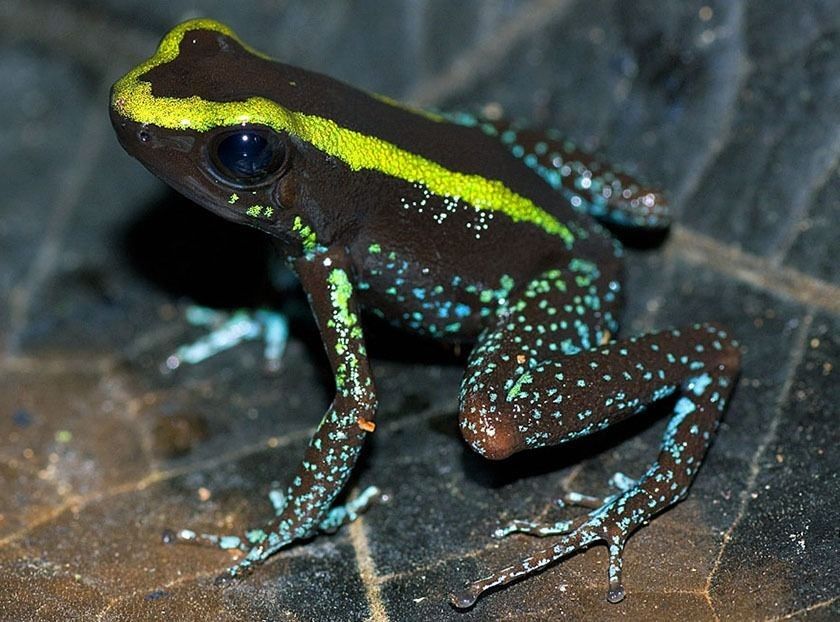
This frog’s striking yellow bands contrast sharply against its black body, making it highly visible even in dense rainforest environments. Native to parts of Colombia and Panama, it relies heavily on its warning coloration to survive.
Its skin contains alkaloid toxins that interfere with nerve transmission, causing disorientation and paralysis in predators. While not commonly fatal to humans, contact can still lead to severe irritation and neurological symptoms.
The yellow-banded poison dart frog spends much of its time on the forest floor, where it hunts small insects and arthropods that supply the toxins it stores in its skin.
9- Lehmann’s Poison Dart Frog

Lehmann’s poison dart frog is one of the most endangered poison frogs in the world. Native to Colombia, it exists in only a few isolated populations due to habitat destruction and illegal collection.
This species exhibits bright red, orange, or yellow coloration combined with dark markings, signaling its toxicity clearly. Its chemical defenses are strong enough to be lethal to small predators and extremely dangerous to humans upon direct contact.
Because of its rarity and beauty, Lehmann’s poison dart frog has been heavily targeted by collectors, pushing it dangerously close to extinction.
10- Granular Poison Frog

The granular poison frog is found in Central America and is known for its rough-textured skin, which gives it a slightly bumpy appearance. Its coloration varies widely, ranging from bright green to yellow or orange.
Its toxins are milder than those of some South American species but still effective as a deterrent. Predators that attempt to eat this frog often experience nausea and muscle weakness shortly after.
This species is especially active during the rainy season, when insect prey is abundant and breeding conditions are ideal.
11- Phantom Poison Frog

The phantom poison frog is named for its ghostly pale coloration, often appearing white or light gray with faint markings. Native to Colombia, it inhabits cloud forests and high-elevation rainforests.
Despite its delicate appearance, this frog carries potent skin toxins. These chemicals disrupt nerve signaling and can cause paralysis in predators. Its rarity and remote habitat have made it difficult to study, leaving many aspects of its biology still unknown.
12- Golfodulcean Poison Frog

Found only in a small region of Costa Rica, the Golfodulcean poison frog is one of the rarest poison frogs in Central America. It displays bold black and orange coloration that serves as a clear warning.
Its toxins are moderate but effective, and its limited range makes it highly vulnerable to habitat loss. Conservation efforts focus on protecting remaining forest areas to prevent its disappearance.
13- Little Devil Poison Frog

The little devil poison frog may be small, but its toxicity is anything but. Native to Colombia, it produces alkaloid toxins capable of causing serious neurological effects.
Its bright red or orange body contrasts sharply with dark limbs, making it easily recognizable. This species is often cited as one of the more aggressive poison frogs, actively confronting rivals and predators alike.
14- Yellow Poison Dart Frog

Closely related to the golden poison dart frog, the yellow poison dart frog shares many of the same chemical defenses, though typically at lower concentrations. It inhabits Colombia’s rainforests and relies heavily on visual warning signals.
Its toxins are still powerful enough to be considered dangerous to humans and lethal to predators. Even brief contact can result in serious symptoms.
15- Splash-Backed Poison Frog

This frog is named for the splash-like patterns on its back, which vary between individuals. Found in Ecuador and Colombia, it occupies humid forest environments near streams.
Its toxins provide reliable protection against predators, while its coloration helps break up its outline among leaves and shadows. Like many poison frogs, it exhibits complex parental care behaviors.
16- Reticulated Poison Frog

The reticulated poison frog displays intricate net-like patterns across its body, making it one of the most visually striking species on this list. Native to parts of Ecuador, it relies on both visual warning signals and chemical defenses to survive.
Its toxins are potent enough to incapacitate predators quickly, though it remains non-aggressive toward humans. Habitat loss poses the greatest threat to its survival, highlighting how even highly toxic species are not immune to environmental change.
Together, these sixteen poison frogs illustrate how evolution can turn tiny animals into some of the most chemically dangerous creatures on Earth. Their vivid colors, complex behaviors, and powerful toxins serve as both warning and protection—proof that in nature, survival often depends on chemistry rather than size or strength.